HomeGalleryFAQAdvice
Contact
Troubleshooting · September 6, 2026
Short answer: a brief, slight dip when the compressor starts is normal — the largest motor in your house is drawing a big inrush current for a fraction of a second. What is not normal is a deep dim, a dim that lasts more than a moment, dimming that has gotten worse over time, or flickering that happens without the AC. Those point to a loose connection, an undersized or failing service, or a utility-side problem.
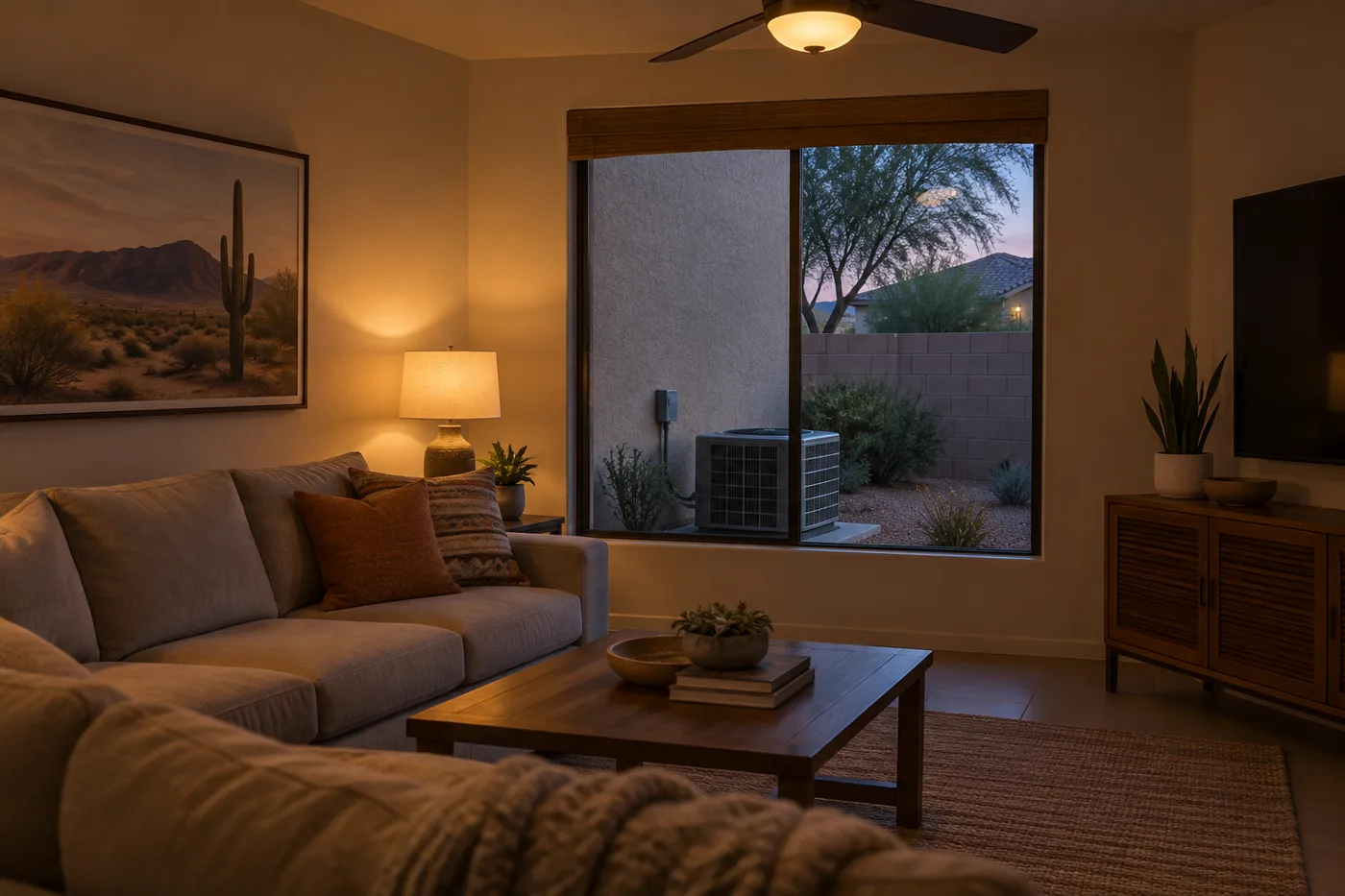
An air conditioning compressor is an induction motor. For the first fraction of a second after it energizes, it pulls several times its running current before it comes up to speed. That inrush causes a momentary voltage drop across everything between the utility transformer and your panel. Incandescent and some LED lamps show that dip as a quick flicker. On a healthy system it is small and it is over before you finish noticing it.
Loose or corroded connections are first on the list. A terminal that was never fully torqued, aluminum service conductors landed without the right treatment, a lug that has loosened through decades of Phoenix heat cycling — each of these adds resistance, and resistance shows up as voltage drop under load and heat at the connection. This is the failure mode that also starts fires, which is why we take a worsening dim seriously.
Second is service capacity. A 100-amp service that was adequate for a 1960s house with one evaporative cooler is working much harder with a modern condenser, a pool pump, a second refrigerator and an EV in the garage. The system is not failing; it is simply at its limits, and every large motor start shows up in the lights.
Third is a lost or weak neutral, either in your panel or on the utility side. This one is the reason we ask whether lights in one part of the house get brighter while others get dimmer. That symptom means voltage is shifting between the two halves of your service, and it can damage electronics and appliances quickly.
Fourth is the air conditioner itself. A failing start capacitor, a contactor with pitted points, or a compressor that is struggling to start will draw inrush for far longer than it should. Sometimes the correct answer is that you need an HVAC technician, not an electrician, and we will tell you that.
Two reasons. Our cooling loads are large and they run for months, so compressors cycle constantly from May through September and any weak connection gets exercised thousands of times. And a lot of Central Phoenix housing stock was wired for a much smaller electrical life than the one being lived in it today. The house did not change; the load did.
Sometimes the finding is a single loose lug and the fix takes one visit. Sometimes the service really is undersized and the conversation turns into a panel or service upgrade. We would rather measure it than guess, because those two outcomes are very far apart and nobody should be sold the second one when they need the first.
If your lights are dimming and you want it looked at properly, call B and D Electric at (480) 828-1181.
B and D Electric LLC is licensed in Arizona (ROC 361086), bonded through RLI Surety and carries $1M/$2M general liability through Clear Spring. Our two owners bring over 40 years of combined experience in Phoenix-area electrical work.

Tell us what's going on and we'll give you a straight answer and a free written estimate. No pressure, no upsell.