HomeGalleryFAQAdvice
Contact
Surge protection · August 30, 2026
Short answer: if your house has expensive electronics, a variable-speed pool pump, a modern HVAC system, LED lighting or an EV charger, whole-house surge protection is one of the cheapest pieces of insurance you can add to a Phoenix home. Here is what it actually does, and what it does not do.
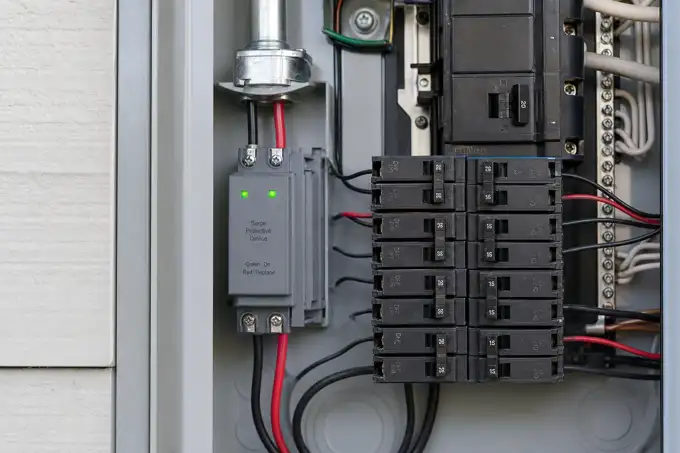
A whole-house surge protective device (an SPD, formerly called a TVSS) is a component installed at your electrical panel. Its job is to clamp voltage spikes coming in on the service conductors and divert that energy to ground before it reaches your branch circuits. It is not a battery, it is not a UPS, and it does not keep your lights on during an outage. It sits there doing nothing until the moment it is needed.
Monsoon season runs roughly mid-June through the end of September, and it brings the two things surges love: lightning and unstable grid conditions. You do not need a direct strike on your roof for a surge to reach you — a strike anywhere on the distribution network nearby, or the sudden restoration of power after an outage, can put a spike on the line. On top of that, our summer load profile means utilities and big neighborhood loads are switching hard all day, and the largest motor in your own house — the air conditioner — creates internal surges every time it cycles.
People expect a bang and a burn mark. What usually happens is quieter: the electronics in equipment degrade over years of small spikes and then fail early. LED drivers, dimmers, HVAC control boards, pool pump controllers, garage door openers, smart thermostats, appliance boards, network gear. When we get called out because 'a bunch of things stopped working after the storm,' it is normally the control electronics that died, not the motors.
Plug-in surge strips are useful and we are not telling you to throw them away. But they only protect what is plugged into them, they have a limited energy rating, and many of them quietly stop protecting long before they stop providing power — the indicator light is the only thing telling you, and most people never look at it. Nothing plugged into a strip covers your hardwired equipment: the AC condenser, the furnace or air handler, the pool equipment, hardwired lighting, the range, the EV charger.
Open your panel door — the outer door, not the cover — and look for a small module mounted to the side of the panel or occupying a breaker slot, usually with a green status LED. If the LED is off or red, the device has taken its hits and needs replacing. If you do not see anything like that, you almost certainly do not have whole-house protection. Do not remove the panel cover to look; that is our job.
Yes. An SPD absorbs energy every time it works, and it has a finite capacity. After a severe event, or after enough small ones, it stops protecting. That is why the status indicator exists and why it is worth a glance at the start of every monsoon season. Replacing a spent device is a small job compared to what it was protecting.
The natural time is when you are already having panel work done — a panel or service upgrade, an EV charger install, a pool equipment circuit — because the panel is open and the labor overlaps. It can also be done on its own as a standalone visit. If you want a straight answer about whether it makes sense for your specific house, call B and D Electric at (480) 828-1181 and we will look at your panel, your grounding and what you are actually trying to protect.
B and D Electric LLC is licensed in Arizona (ROC 361086), bonded through RLI Surety and carries $1M/$2M general liability through Clear Spring. Our two owners bring over 40 years of combined experience in Phoenix-area electrical work.
Tell us what's going on and we'll give you a straight answer and a free written estimate. No pressure, no upsell.